

In Defence of Telling
Tell, don't show?

[As the “set up” chapters for Show Home are now complete, I am going to take a little break over Christmas and New Year to consider how to best pose and pace the narrative to come… In the meanwhile, I will post a few non-fiction pieces in the usual Sunday slot.]
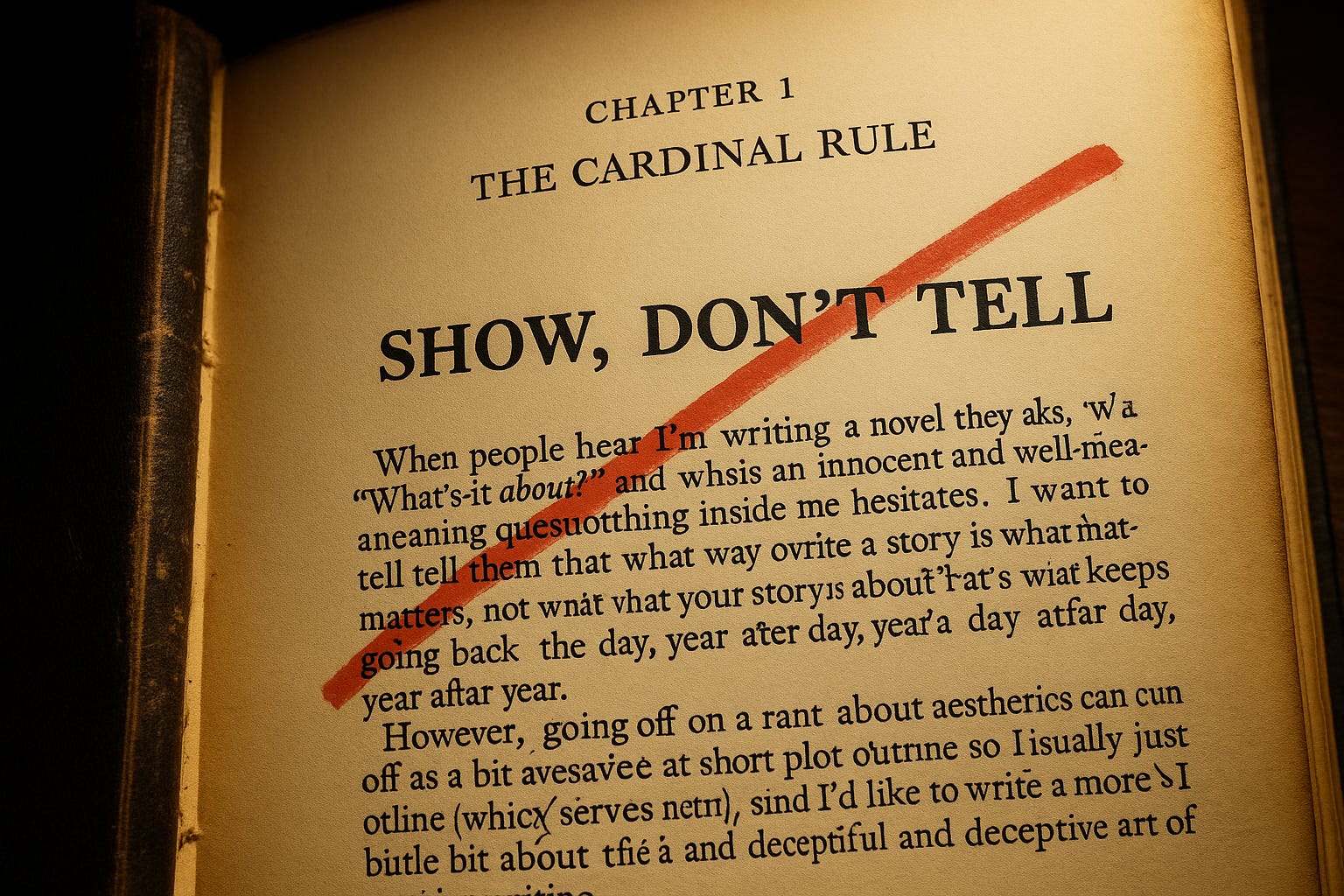
This piece deliberately undermines my previous article on showing, not telling. I want to argue, plainly, for telling. Not to advocate for replacing proof and detail in fiction, but to acknowledge that the “Show, don’t tell” rule can and should be broken.
"Show, don't tell" is sensible advice until it becomes superstition. Treating every sentence as a specific, concrete proof is only useful if the wider story is visible. Much of a novelist’s work lies not in proof but in proposition: this is what mattered; this is what it added up to; this is what it meant. Telling names the meaning so that details have something to attach to. Otherwise we risk texture without shape.
I spend long hours editing, chasing rhythm, pruning slack, and have learnt to treat certain lines as structural beams. A plain, declarative statement can hold the weight of a chapter. It can move the reader across years in a sentence and help them arrive with the right emphasis. Summary is not laziness. It is proportion. It chooses the story’s scope and scale so that the sensory experiences arrive when and where they should.
The fear, I think, is that telling will blunt feeling. We worry that a sentence like “Anna was unhappy” is thin. But telling can sharpen attention rather than dull it. If you say she was unhappy, the reader begins to ask questions: in what way, and why? The following scene does not have to carry the whole burden of discovery. It can serve the idea you have already named. The lens is pointed in the right direction before you focus on the incident.
Abstraction is not the enemy of experience. It is experience organised. When you say “the marriage failed”, you draw a frame that stops readers’ minds from wandering. Within that frame, a touch or a silence does more work. You can tell first, so that showing can be selective. The effect is cleaner. The page breathes. You are no longer obliged to stage an extended scene to prove a simple idea.
There is also a question of ethics and tone. You might not want to stage every moment. Telling lets you respect a character’s privacy or dignity without flinching from their truth. Summary can be merciful. It can spare the reader voyeurism and keep a character from being reduced to aestheticised pain. A single line can acknowledge harm without turning it into horror.
This is not a defence of fog. Telling has to be active, not evasive. It is not the same thing as the passive voice. “Mistakes were made” is not telling; it is hiding. Good telling uses verbs that take responsibility. It says who knew, who chose, who changed. It names the stakes. It provides clarity.
One of the under-praised virtues of telling is in pacing. Readers bring busy lives to the page. They do not need to watch your character cross the room twenty times. They do need to know why the room matters and what crossing it will cost. A paragraph of clean summary can carry them across the room countless times with the correct emphasis preserved. It can make space for the scene that follows to do the precise work only a scene can do.
Exposition is not an interruption to the novel; it is one of its voices thinking aloud. That thinking reveals values. It arranges patterns. It draws a line through the fragments and says: this is the path. There is music in that, if you attend to its cadence. Argument has rhythm. A page of carefully chosen statements can be as pleasurable as a stream of sensory description because it can leave the reader feeling informed and well led.
Readers do not only want to be shown. They want to be guided. It is reasonable to explain what this episode means in the lives we’re observing. It is reasonable to announce the stakes before you test them. It is reasonable to close a chapter with a judgement won by what has been seen. These are not shortcuts. They are the parts of storytelling that take responsibility for making sense.
How do you tell well? Start with proportion. Give a line to what wants a line and a page to what earns a page. Use sequence as logic: past to present, cause to effect, claim to evidence. Prefer verbs of knowledge and change: learnt, decided, refused, became. Place the hardest fact where the paragraph has prepared a place for it. Keep modifiers honest. A sentence should stay only if removing it would diminish meaning.
Most of the time, the answer is to blend. Tell to set the scope, show to test the proof, tell to read the result. Or invert it. Show first and let the declarative sentence land like a verdict. The only rule is to make your choices visible to yourself. If you know why this sentence is a statement and the next one is the start of a scene, you are writing with intent.
Fiction asks readers to suspend disbelief and live inside a temporary reality made of words. We keep them immersed by proof, yes, but also by promise. Telling is the promise: keep going, this is where we’re headed. Showing delivers on that promise. When both are present, boredom is held at bay not by spectacle but by direction. The mind feels it is learning something, not merely watching it.
A better maxim might be: ‘create meaning, and make it felt’. If telling is the truest way to carry the meaning, let it stand. If the moment deserves air, build the scene. Either way the aim is the same. You are trying to reproduce the emotional impact of real experience and make sense of it. You are proving and you are naming. Telling is not the enemy of proof. It is the reason that proof matters.